Skip to content

Pikaboo, by Timbuk2 · South Africa

See what is really happening out there.

Pikaboo gives brands, agencies, media owners and sales teams evidence they can act on: who passes a billboard, whether a campaign ran, which message lands, what is on the shelf and where to sell next. Measured from real movement and real people. Checked in person.

Pikaboo's FOONA field team in Pikaboo T-shirts in front of a community mural in Cape Town
FOONA field team · Cape Town

Out-of-home media

For media owners, agencies and the advertisers who pay for the boards.

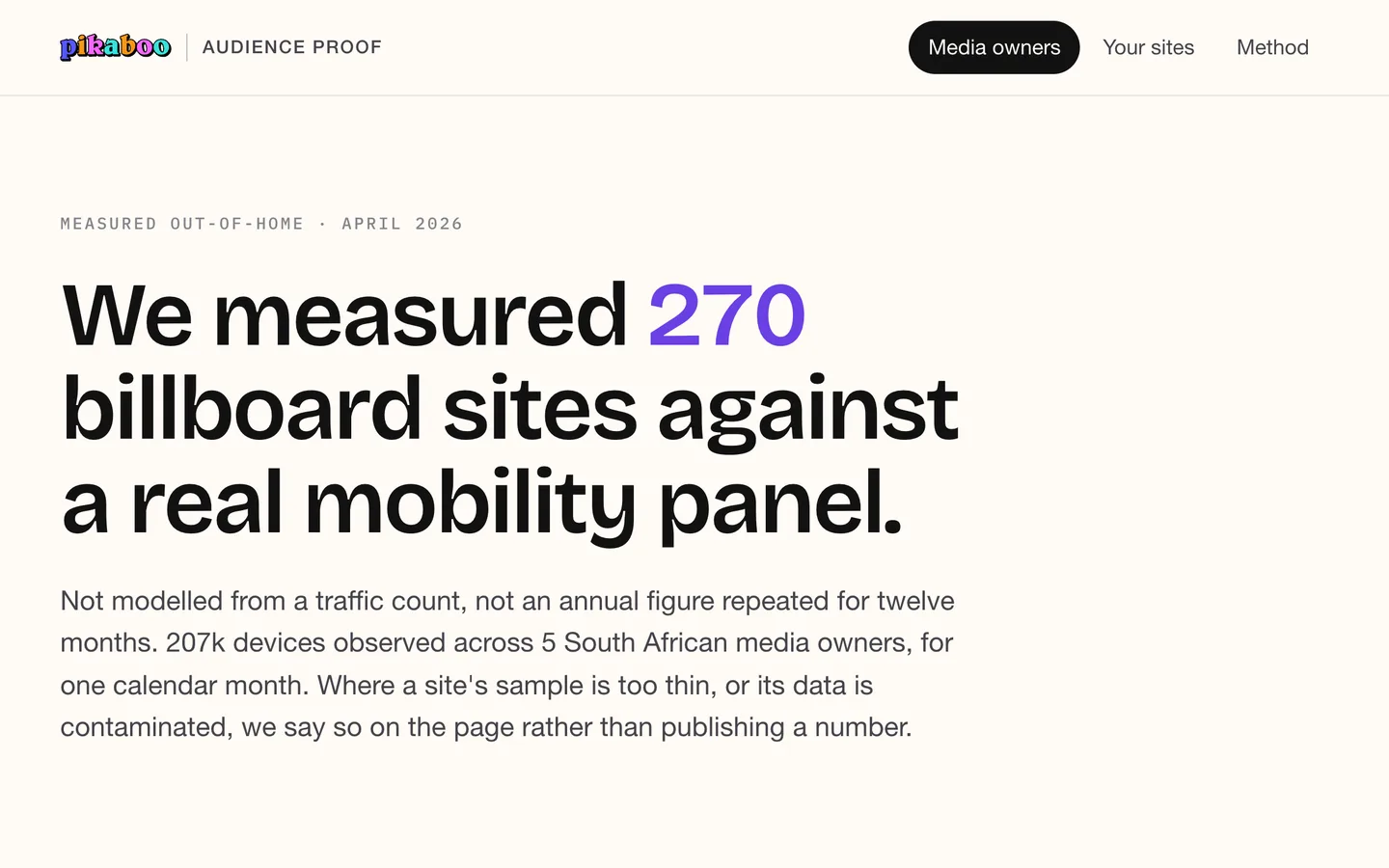
The Pikaboo Audience Proof site, showing billboard sites measured against a mobility panel
Live product · measure.pikaboo.ai

Pikaboo Measurement

How many people really pass the board?

Media owners, planners and agencies

Audience for each site, counted from anonymised mobile movement every month, not a traffic count repeated all year. Reported as reach, VAC and frequency, the terms your buyers already use. Where a site's sample is too thin to trust, we list it and say why.

What you get

A site-by-site audience report for your estate, deduplicated across the network.

Live. Five South African networks published in full.
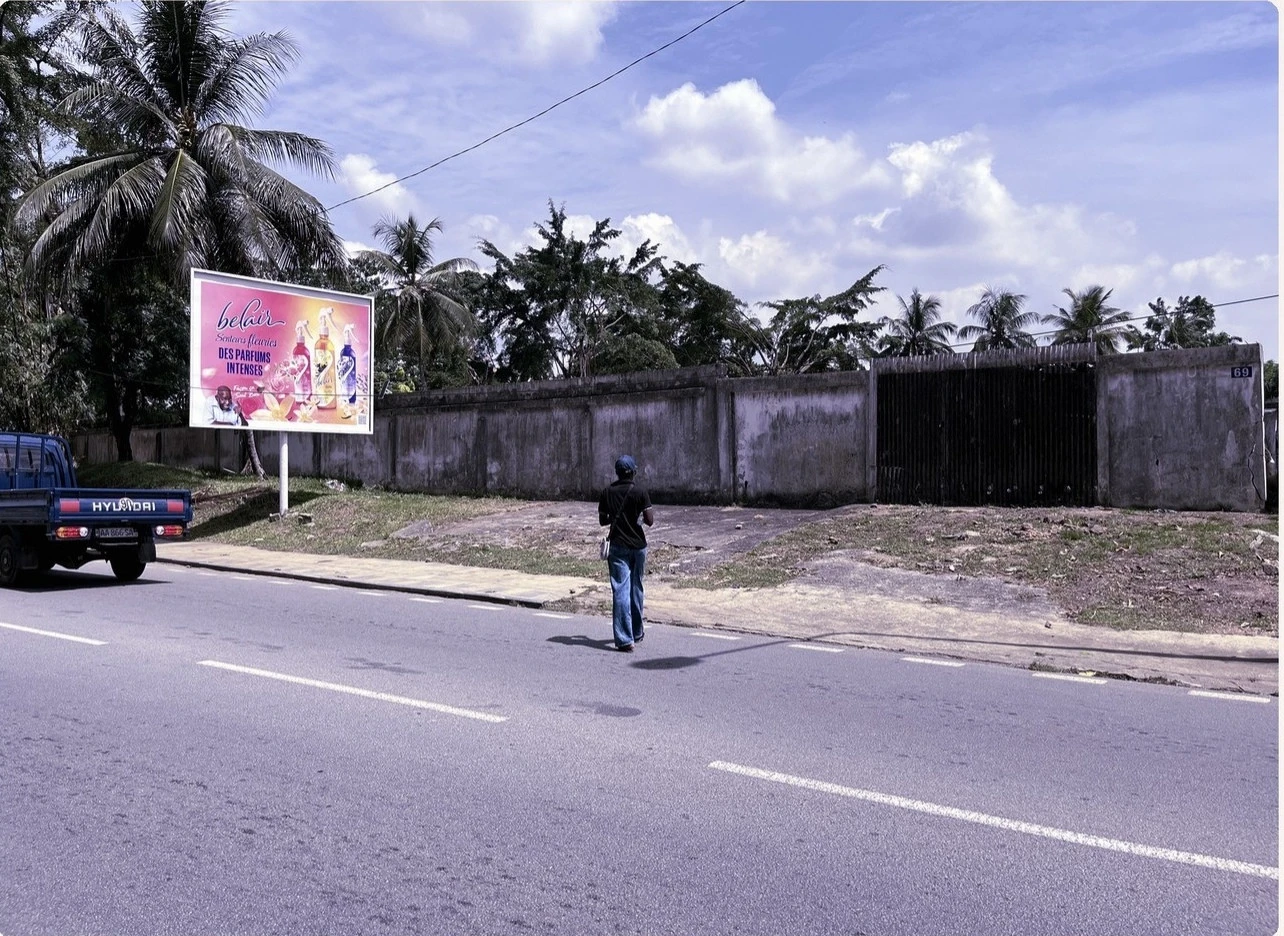
A field collector walking to a roadside billboard to photograph it during a campaign check
Field check · Abidjan, March 2026

Pikaboo Campaign Proof

Did the campaign run where and when you paid for it?

Advertisers and agencies

Our field team visits each face during the flight and photographs it, with the time and place recorded. A person reviews every photo before it reaches your report. Where the media owner's record and ours differ, you see both side by side and decide what to settle.

What you get

A dated, located photo record for every face, with each discrepancy flagged.

Live. Priced per campaign for agencies and advertisers.

Shoppers and shelves

For brand, category and trade teams deciding what to sell, say and stock.

Ask Pikaboo, where you enter two messages and choose the audience who will pick between them
Live product · ask.pikaboo.ai

Ask Pikaboo

Which message will your audience choose?

Marketing, brand and media teams

Put two lines in front of real South Africans before you pay for the media. People answer inside 2Klip, our mobile game, mostly in township and spaza-shop neighbourhoods. You see who chose what, and why, in days rather than weeks.

What you get

The winning message, who chose it, and what the result can and cannot tell you.

Live. Free to try, no sign-up.

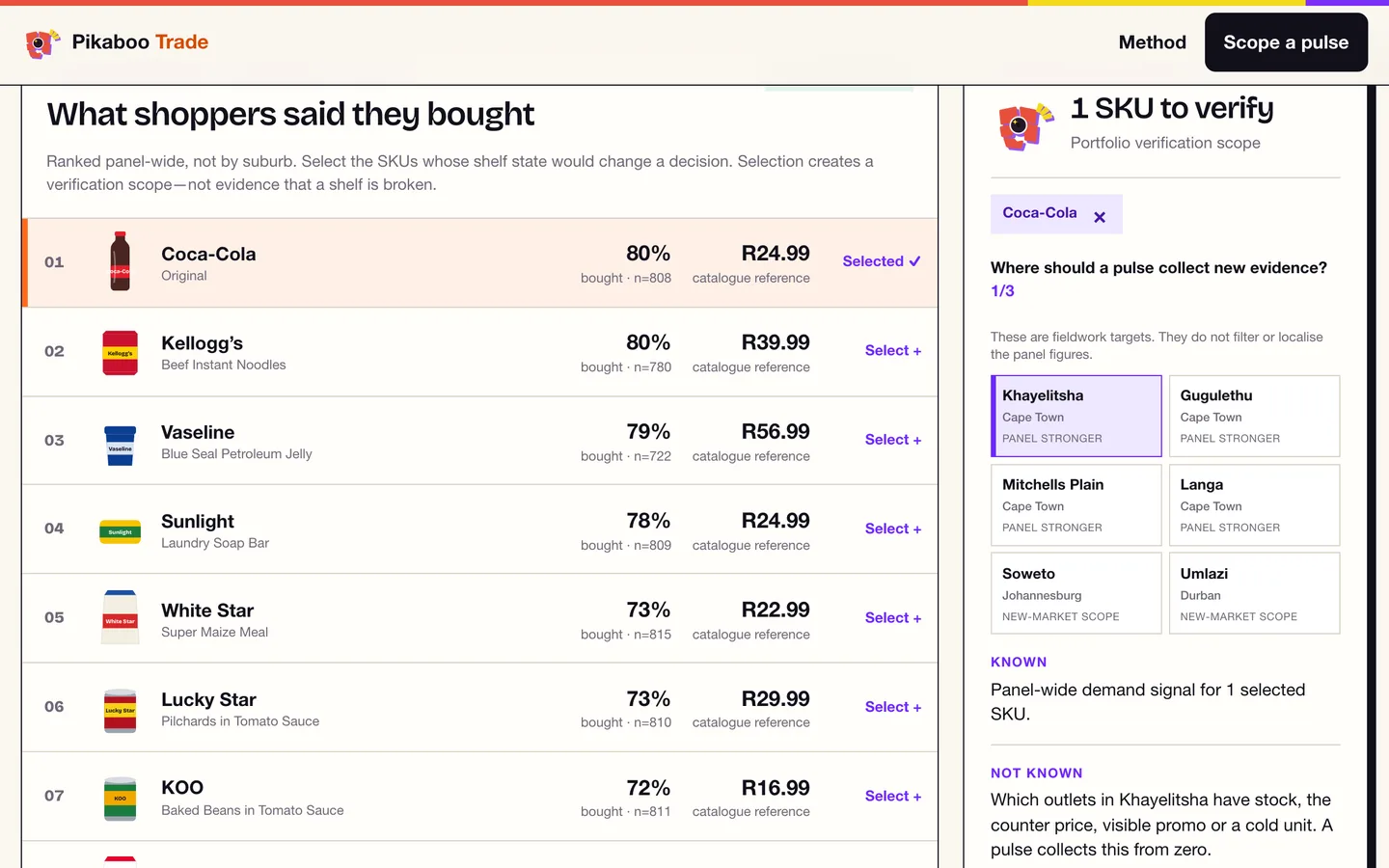
Pikaboo Trade, listing the products shoppers said they bought, with a shelf check being scoped
Live product · trade.pikaboo.ai

Pikaboo Trade

Is your product on the shelf, at the right price, this weekend?

FMCG brand, sales and trade-marketing teams

Start with what shoppers say they bought, from the 2Klip panel. Then send our field network to the outlets that matter, spaza shops and informal stores included, to check stock, price, promotion and cold availability for the SKUs you choose.

What you get

A shelf pulse: your chosen SKUs, checked outlet by outlet, with photos and prices.

Pilot. Shopper demand is live; shelf collection opens with the first pilot.

Sales teams

For sales leaders deciding where their people spend the next hour.

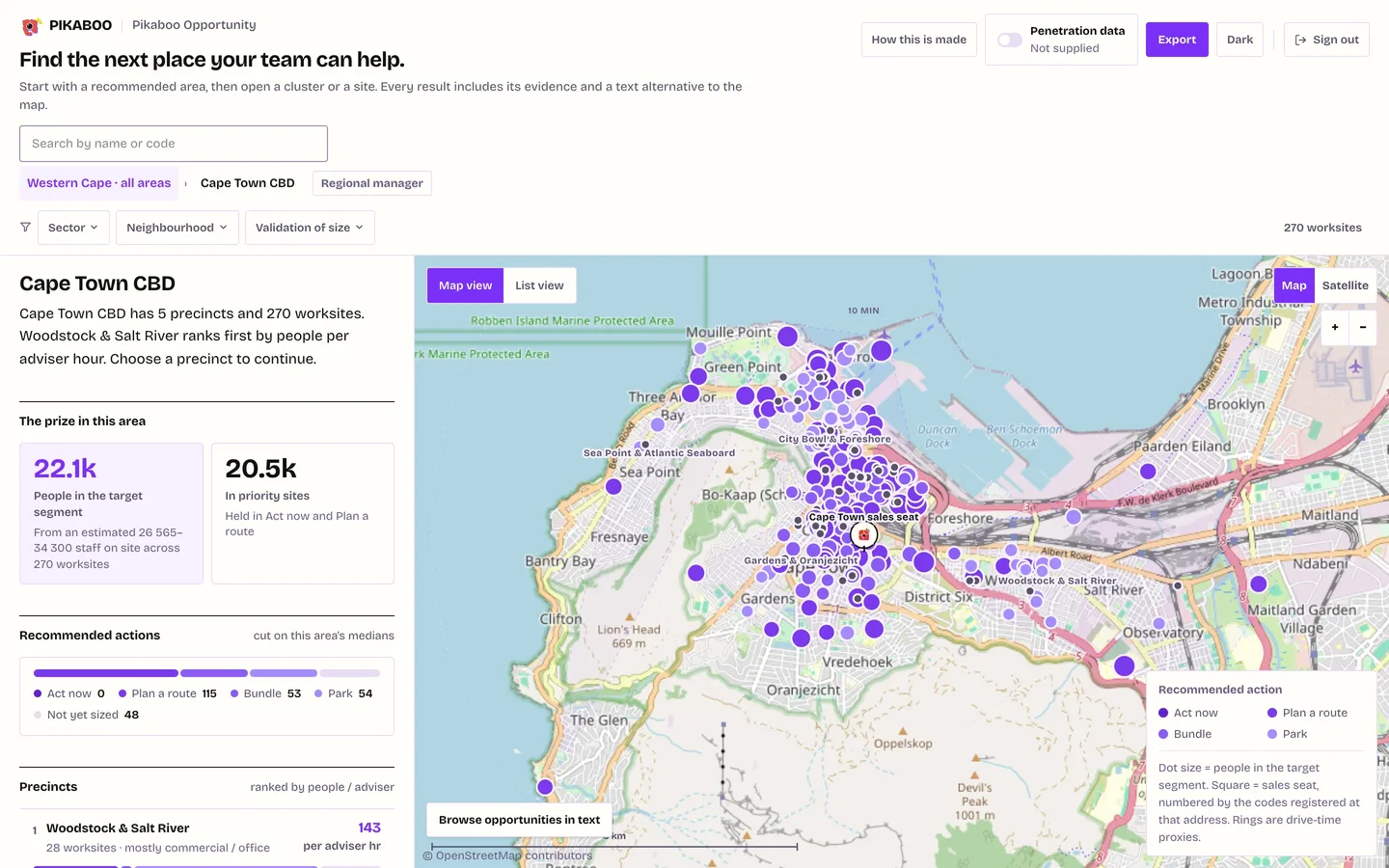
Pikaboo Opportunity, a map of Cape Town CBD worksites ranked for an adviser team
Product capture · demonstration data

Pikaboo Opportunity

Where should your next salesperson go?

Sales leaders and distribution teams

The sales intelligence product in the Pikaboo family: a map of the places your team is not reaching yet. Worksites and precincts are ranked by how many of the people you sell to your team can meet per hour on the ground, and checked against your current book. Each recommendation shows its evidence, so a manager can act on it or rule it out.

What you get

A ranked map and list of places to send your team, with the evidence behind each one.

Live. Sign-in required; set up on your own territory.

Why Pikaboo

Evidence you can defend in the room.

  • Measured, not assumed

    Numbers come from observed movement and real answers, each with a date and a source. When a sample is too thin to trust, we say so instead of printing a figure.

  • Checked in person

    FOONA, our field network, visits the billboard, the shop and the street to confirm what the data says, with a photo, a time and a place for every check.

  • Built around your decision

    Every report starts with the decision it informs and ends with what you can, and cannot, conclude from it. No proprietary score to take on trust.

Pikaboo Measurement, in detail

Measured from movement. Verified on the ground.

Pikaboo reports reach, VAC and average frequency for out-of-home panels in South Africa. Audience is computed from anonymised mobile movement and updated daily. The panel itself is confirmed in person.

10M+
devices seen monthly
1B+
location signals processed
Daily
measurement granularity

Metrics

Audience metrics, defined in plain language

No new metric to learn and no proprietary score to take on trust. If you plan out-of-home, this is already your vocabulary.

Reach people

How many different people passed the site.

Unique devices seen at the site over the measurement period, counted once each rather than once per passing, then scaled to the resident population of the areas they come from. The result is an estimate of people, not a count of them.

VAC visibility adjusted contacts

How many were in a position to see the panel.

Contacts adjusted by a visibility factor derived from the physical characteristics of the panel and its setting. Passing a site is not the same as seeing what is on it.

Average frequency exposures per person

How often each of them passed it.

Total contacts divided by reach over the measurement period.

GRP gross rating points

The same exposure expressed as a share of the population.

Reach as a percentage of the population of the areas measured, multiplied by average frequency. The denominator is the StatsSA Census 2023 population for those areas, the same basis used to scale reach, so a rating point here means what it means elsewhere.

Methodology

Built against the international definitions

Pikaboo computes reach, VAC and frequency using the definitions set out in the ESOMAR Global Guidelines for Outdoor Advertising and the World Out of Home Organisation's recommended approach to digital out-of-home audience measurement. These are the references on which out-of-home currencies are recognised internationally.

Pikaboo is not an accredited currency and does not present itself as one. Independent methodological validation is in progress. The method is documented in full and open to third-party audit.

That is the basis for measurement. Every other product states its own: Campaign Proof, Ask Pikaboo, Trade and Opportunity each publish what their evidence is, and what it does not establish, on their own page.

The measurement method, step by step

Difference

What this method makes possible

01

No hardware at the panel

Nothing is installed on the structure, so measurement is not limited to sites that have been instrumented and does not wait on deployment. Any panel with a known position can be measured, including transit, township and place-based inventory.

02

Audience and delivery, reported separately

An audience estimate says how many people could have seen a panel. It cannot say whether the poster went up, stayed up, or faced the right way. Field verification answers that, and the two are never combined into a single number.

03

A method you can check

The definitions, the processing chain and the known limitations are published. Buyers, sellers and auditors are looking at the same document, and it is open to independent review.

04

Current, not periodic

Audience is recomputed continuously rather than released on a cycle, so a campaign booked this month is planned against movement from this month.

Buyer questions

Before you measure a billboard

What is out-of-home audience measurement?

Out-of-home (OOH) audience measurement estimates the audience for advertising in physical places, including billboards and transit panels. Pikaboo combines anonymised mobile movement, population scaling and panel visibility to report reach, visibility adjusted contacts (VAC) and average frequency in South Africa.

What is the difference between reach, VAC and frequency?

Reach estimates how many different people passed a site during the measurement period. VAC adjusts contacts for the opportunity to see a panel. Average frequency is total contacts divided by reach. These are modelled audience measures, not a count of people who looked at an advert or bought a product.

Does an audience estimate prove that a campaign ran?

No. Audience measurement and campaign delivery are separate claims. FOONA field checks capture dated and located evidence of the panel and creative. That evidence can confirm presence; it does not by itself establish attention, sales lift or causal campaign impact.

What do I need to request billboard measurement?

Start with a site list, panel positions and orientations, the measurement period and the planning decision. Pikaboo can scope reach, VAC and average frequency for the inventory. Agree coverage, field checks, timing and price before commissioning the work.

Is Pikaboo an accredited audience currency?

Pikaboo is not an accredited currency and does not present itself as one. Independent methodological validation is in progress. The method is documented in full and open to third-party audit.

Can I see measured audiences in the public Media preview?

The public planning preview lets you explore 12 Cape Town areas and build a shareable brief without an account. Audience reach, VAC and demographic profiles are not yet published in that preview. The methodology describes the measurement service; a planning area is not a published audience result.

Start with one question.

Tell us the decision, the place and the deadline. We will tell you which product answers it, what it costs and when you will have the evidence.